


Ever given a partner a back rub purely because you wanted to, no motive attached? And ever gone along with sex you weren't really that fussed about, because saying no in the moment felt harder than just getting on with it? Both of those are common, and most of us never stop to name what's …


Ever given a partner a back rub purely because you wanted to, no motive attached? And ever gone along with sex you weren’t really that fussed about, because saying no in the moment felt harder than just getting on with it?
Both of those are common, and most of us never stop to name what’s actually happening in either one. That’s exactly the gap Betty Martin’s wheel of consent was built to close, and it’s a model I bring into the therapy room often, because once people see the four quadrants, they tend to recognise their own sex life in it almost immediately.
Who is Betty Martin, and where this comes from
Dr Betty Martin developed the wheel of consent over three decades of hands-on work as a chiropractor, sexological bodyworker and educator, watching the same patterns turn up again and again in how people touch and are touched. She co-founded the School of Consent and laid the model out fully in her book The Art of Receiving and Giving: The Wheel of Consent, written with Robyn Dalzen (Martin & Dalzen, 2021).
It’s a named, trademarked framework tied to Martin specifically, worth crediting properly rather than treating as generic consent advice.
The two questions underneath every touch
The whole model rests on two questions, asked about any moment of touch:
Who’s doing the action?
Who is it for?
Put those on perpendicular axes and you get four quadrants: giving, taking, receiving and allowing. None is better than the others. The aim isn’t picking a favourite, it’s having access to all four, rather than getting permanently stuck in one or two, which is where a lot of the couples I see have ended up without realising it.
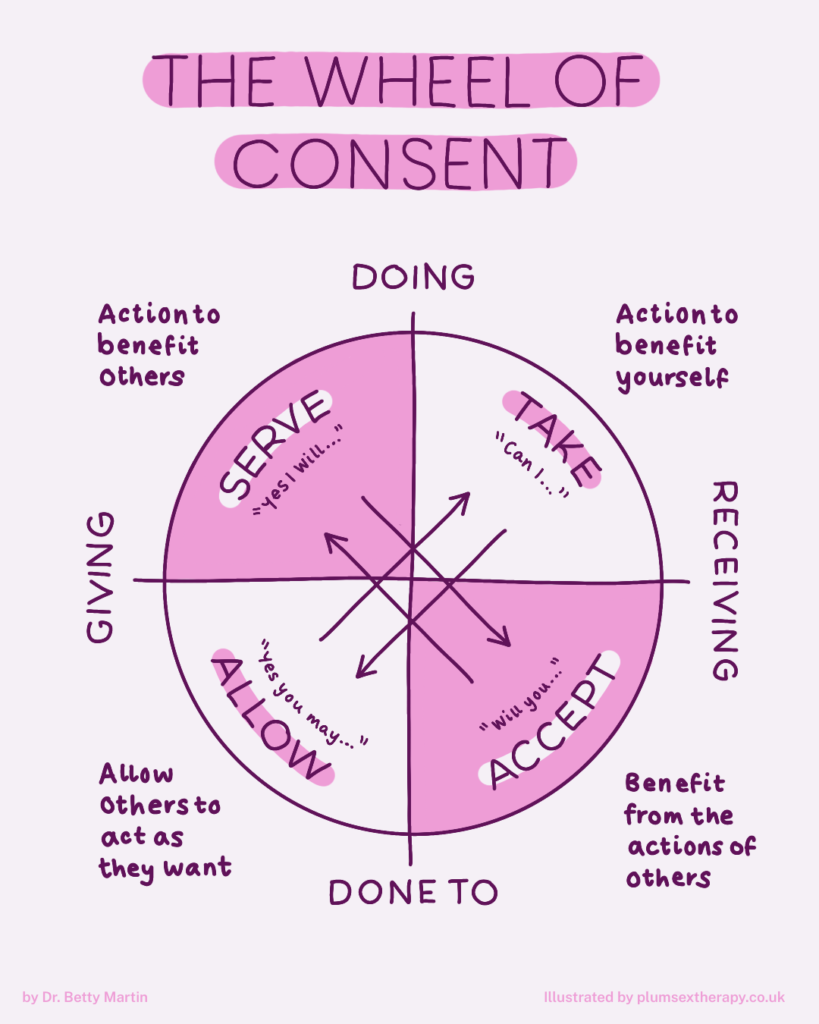
The four quadrants
Giving is you doing the touching, for the other person. The question underneath it is “how would you like me to touch you?” It’s an act of generosity, offering your hands in the shape someone actually wants, not the shape you’re assuming they want.
Receiving is the other person doing the touching, for you. The question is “will you touch me here?” It means asking for exactly what you want and actually letting it land, rather than deflecting the pleasure or apologising for taking up the space to ask.
Taking is you doing the touching, for you. The question is “may I touch you there?” This is the one I see the least practice with in clients, especially anyone raised to see their own wanting as an imposition on someone else.
Allowing is the other person doing the touching, for them. The question is “how would you like to touch me?” It means letting someone have their own experience of you without steering it, correcting it, or performing enjoyment you don’t feel on top of it.
Giving pairs with receiving. Taking pairs with allowing. In a clear exchange, both people know which role they’re each in, so nobody’s guessing.
“Want to” versus “willing to”
This is the distinction that tends to land hardest. Giving and allowing only require willingness, not want. Taking and receiving are built on actual want. Neither is more honest than the other, but mixing them up is where a lot of quiet resentment creeps in: agreeing to something out of willingness, then feeling short-changed that your partner didn’t seem to notice you weren’t really into it, when they were never told and never asked.
Getting clear with yourself, and saying out loud which one you’re in, takes a surprising amount of guesswork out of sex. It’s the same territory I talk through in psychosexual therapist vs relationship therapist: what’s the difference?, communication problems and desire problems often look identical from the outside, and this is usually where they start.
The shadow sides of the wheel
Every quadrant has a shadow version, and it only shows up when there’s no clear agreement about who’s doing what, for whom. This is the part of the model that tends to get skipped in the quick explainer versions, but it’s often the most useful part in the room.
Giving without agreement becomes people-pleasing. You do what you’ve assumed someone wants because saying no feels riskier than resenting yourself later. It can look like generosity from the outside, and feel like self-erasure on the inside.
Taking without agreement becomes overstepping. You act on your own want without properly checking whether the other person is actually up for it, sometimes because you’ve talked yourself into believing their silence was consent.
Receiving without agreement becomes entitlement. Pleasure starts to feel owed to you rather than something you ask for, and a partner’s willingness gets quietly mistaken for enthusiasm.
Allowing without agreement becomes enduring. You stay still and get through something rather than genuinely consenting to it, and over time that can flatten into a habit of tolerating touch you never actually wanted in the first place.
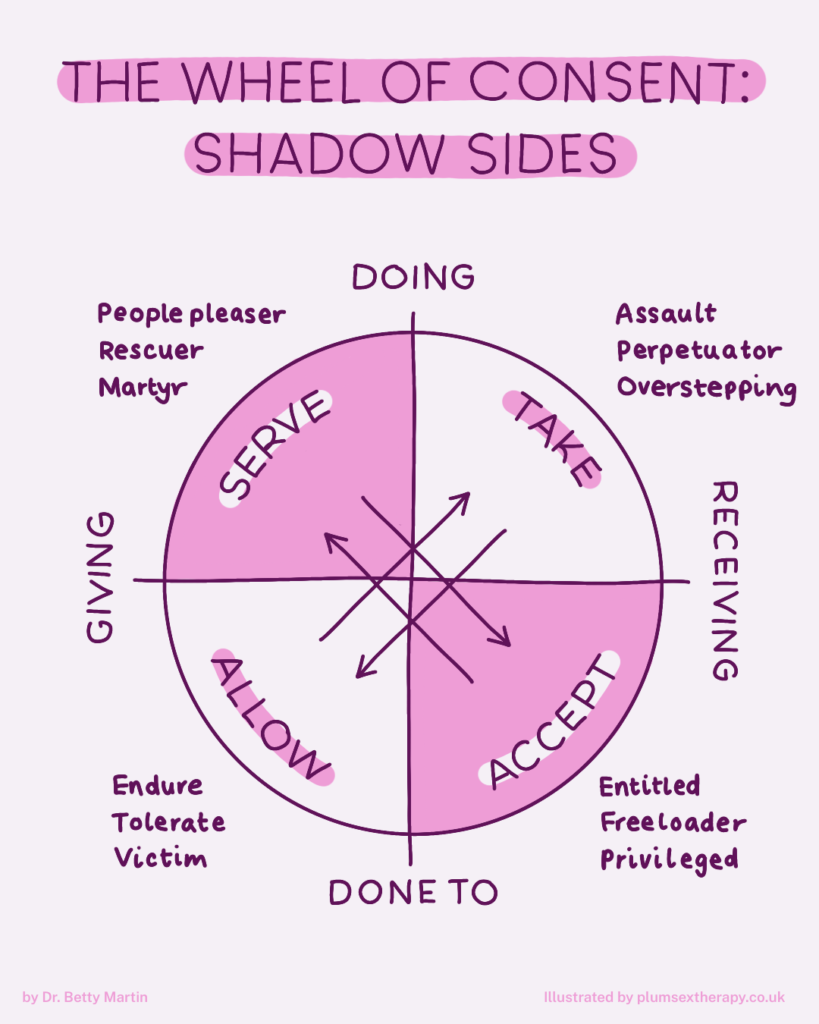
None of this is about blame, and it rarely comes from anywhere malicious. It’s the same territory I map out in the shame cycle: a shadow quadrant triggers something uncomfortable, the discomfort gets pushed down rather than named, and the resentment or shame that builds around it quietly erodes desire long before either person can point to what actually went wrong. Most couples I see aren’t dealing with mismatched desire so much as an unnamed shadow, usually on both sides at once. Naming which quadrant you’re actually in, out loud, is often the fastest way out of it. There’s more on how that pattern takes hold in the role of shame in sex and relationships.
Why this matters just as much five, ten, twenty years in
Consent gets talked about mostly in the context of new partners, first dates, hookups, but the couples I see most often aren’t new to each other at all. They’re five, ten, twenty years in, and the wheel still matters just as much, sometimes more, because it’s exactly the kind of thing long-term couples quietly stop doing.
Early on, you ask because you don’t know yet. What do they like, what don’t they, how do they take their touch. Over time, that map gets built, and asking starts to feel unnecessary, even a bit odd, “why are you checking, we’ve been together fifteen years.” Routine takes over instead: Friday night is Friday night, you know the shape of it, so nobody checks anymore whether either of you is actually in giving, taking, receiving or allowing that night, or just going through the motions of what’s always worked before.
That’s exactly how a shadow quietly becomes a habit rather than a one-off. Desire and bodies both change over the course of a relationship, through stress, health, hormones and life stage, parenthood, grief, and what someone was giving freely five years ago might now be something they’re only willing to do, or barely that. Nobody necessarily notices the shift happening, because from the outside it can look exactly like intimacy carrying on as normal.
Checking in doesn’t need to be clunky or formal to still count. It can be as small as actually asking what someone wants tonight instead of assuming you already know, and it’s not a sign a relationship’s in trouble, it’s ordinary maintenance, the same as any other kind. This is a lot of what comes up in relationship therapy with couples who’ve been together a long time: not that anything went badly wrong, just that nobody’s asked in a while.
The three minute game
Martin and her collaborators built a practice exercise around the wheel called the three minute game, done with a partner, fully clothed if you like, with no goal beyond noticing.
In the take and allow round, one person touches the other in ways they enjoy, inside boundaries the allower has stated in advance. The allower’s only job is to say if a limit is reached, not to guide, please, or perform.
In the give and receive round, the receiver asks for one specific thing, and the giver does exactly that, nothing more and nothing less.
Three minutes is short enough that most people can tolerate the discomfort of being that direct, and for a lot of the couples I work with, it’s the first time either of them has practised asking for touch, or offering it, without something else attached to it.
Where neurodivergence fits in
This model tends to land particularly well with a lot of the autistic and ADHD clients I see, and it’s worth explaining why.
Interoception, the sense of what’s happening inside your own body, is often processed differently in autistic and ADHD brains, which makes the standard “just check in with what you want” advice genuinely unhelpful for a lot of people (Neurodivergent Insights). A model that breaks desire down into four concrete, askable questions gives you something to work with instead of a vague instruction to listen to a body that isn’t sending clear signals.
The explicit, verbal nature of the wheel also suits anyone who finds unspoken social scripts exhausting to read. Instead of guessing what a partner “really” wants from subtle cues, you can just ask which quadrant they’re in, a relief rather than a chore for a lot of neurodivergent people and often for their partners too. This is a big part of what I cover in neurodivergent sex therapy and neurodivergent couples therapy, and it overlaps with the double empathy problem, where two people communicating differently isn’t a deficit in either of them, just a mismatch that needs a shared, explicit system to bridge it.
There’s a crossover too with what’s increasingly reframed as a persistent drive for autonomy, sometimes still labelled pathological demand avoidance, where any sense of obligation can trigger real resistance, even to things a person would otherwise enjoy (Reframing Autism). The wheel’s insistence that giving and allowing are based on willingness, never obligation, tends to sit far more comfortably with that need for autonomy than the usual vaguer scripts around sexual “duty” or “compromise.”
If you recognise yourself in this
I’m a psychosexual and relationship therapist based in Brighton and Hove, and I work with individuals and couples of every gender, orientation, relationship structure and neurotype who are trying to get clearer on exactly this, who’s doing what, for whom, and how to actually say so. That includes LGBTQ+ couples, trans and non-binary clients, and anyone working through general relationship therapy rather than anything specifically sexual.
If you’d like to talk it through, you can find out more about how I work, see pricing, or book a free 15 minute chat to see if it’s a good fit.
FAQs
Is the wheel of consent only for sexual relationships?
No. It was developed through work with touch and sexuality, but the same four quadrants apply to any exchange between people, including friendships, caregiving and non-sexual touch like hugs or massage.
Do I have to use all four quadrants equally?
Not at all. The goal isn’t a perfect balance every time, it’s having access to all four so you’re not stuck defaulting to one, and being honest with a partner about which one you’re actually in.
What’s the difference between taking and receiving?
Both are about your own want, but taking is you doing the action, asking to touch someone in a way you want, while receiving is the other person doing the action, asking them to touch you in a way you want.
What’s a “shadow” quadrant?
It’s what happens when there’s no agreement about who’s doing what for whom, so giving slides into people-pleasing, taking into overstepping, receiving into entitlement, and allowing into enduring. Naming the shadow out loud is usually what breaks it.
Can I use the wheel of consent without doing the three minute game?
Yes. The framework itself, asking who’s doing this and who it’s for, is useful on its own, even if you never try a formal exercise around it.
Why does consent still matter once you’re in a long-term relationship?
Because want and willingness both shift over time, and routine can quietly replace checking in. Nobody needs to have done anything wrong for that to happen, it’s just what unattended habits do.
References
- Martin, B., & Dalzen, R. (2021). The Art of Receiving and Giving: The Wheel of Consent. Luminare Press.
- Alison, R. The wheel of consent, simply explained. School of Consent. https://www.schoolofconsent.org/blog/wheel-explained
- Moyle, K. (2023). The Science of Sex: Every Question About Your Sex Life Answered. DK/Penguin Random House.