


Often clients will say their desire has "just switched off," usually with a fair amount of worry underneath it, sometimes about the relationship, sometimes about whether there's something wrong with them specifically. The question underneath the question is almost always: am I broken, or is my partner just not enough anymore. Often it's neither. What's …


Often clients will say their desire has “just switched off,” usually with a fair amount of worry underneath it, sometimes about the relationship, sometimes about whether there’s something wrong with them specifically. The question underneath the question is almost always: am I broken, or is my partner just not enough anymore.
Often it’s neither. What’s actually happened can often be more mechanical than that, and a lot less personal.
What the dual control model actually says
The model comes from sex researchers John Bancroft and Erick Janssen at the Kinsey Institute, and it replaced a much older, much less useful idea: that sexual arousal is one dial, running from off to on, and low desire just means the dial’s been turned down.
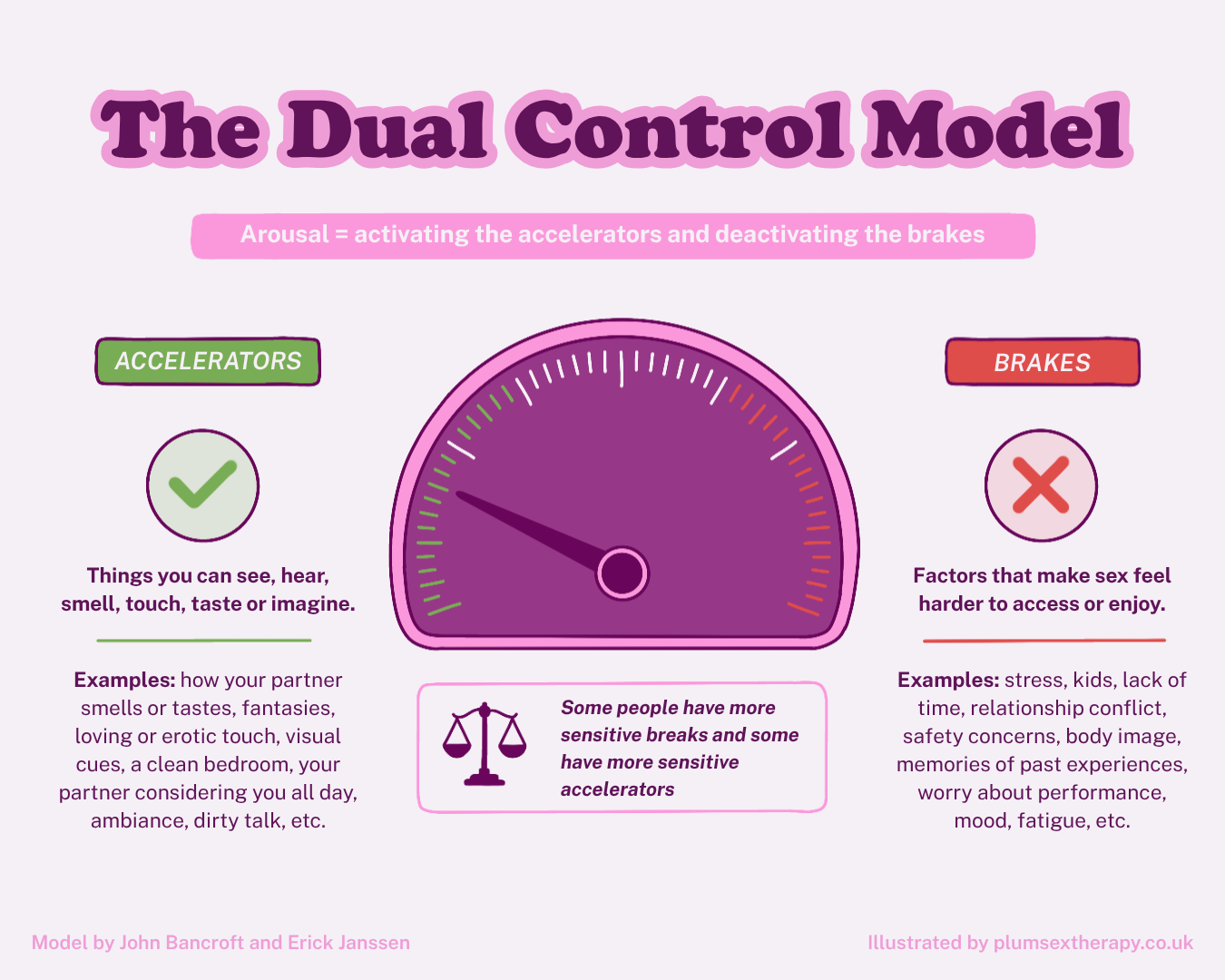
Their research found something different. Arousal runs on two separate systems that operate more or less independently of each other: a sexual excitation system, which notices and responds to anything that could be arousing, and a sexual inhibition system, which is constantly scanning for reasons to hit the brakes. Your arousal in any given moment isn’t the excitation system’s reading on its own. It’s excitation minus however many brakes are currently pressed down.
Which means two people can have identical accelerators, respond to exactly the same things, and still end up with completely different sex lives, because one of them is carrying three brakes and the other one isn’t carrying any.
Meet your accelerator
This is the part most people already think of as “libido”: what you notice, what you respond to, what catches your attention. Some people have a more sensitive accelerator than others, and neither is a problem to fix. It’s just wiring.
But a sensitive accelerator with the brakes on will still produce no arousal at all, which is the part the old one-dial model could never explain.
Meet your brakes, because there are two of them
Bancroft and Janssen actually split the inhibition system into two, and the distinction matters more than it looks like it should.
Brake one: will this work. This is inhibition driven by worry about the sexual response itself, whether you’ll get or stay aroused, whether your body will do the thing you want it to do. Performance anxiety lives here, and so does the low-grade self-monitoring a lot of people do without noticing they’re doing it, watching their own arousal instead of experiencing it.
Brake two: what happens if it does. This is inhibition driven by the context around sex rather than the sex itself: whether the kids might walk in, whether you’re too tired to do this properly and don’t want to disappoint anyone, whether this feels safe, whether there’s unresolved conflict sitting in the room with you, whether your body image is loud tonight, whether a past experience taught you that this particular kind of vulnerability doesn’t end well.
Two completely different brakes, doing two completely different jobs, and most people have never separated them, so “I’m just not in the mood” ends up covering for a specific, findable brake that’s actually quite easy to name once you go looking.
Why “just relax” or “get in the mood” doesn’t work
Because neither of those does anything to the brakes. Telling someone with three brakes on to press the accelerator harder just produces a more frustrated person with the same three brakes still on.
The far more useful question isn’t “why don’t I want this,” it’s “what’s currently braking, and is it brake one, brake two, or several of each.” Once you can name it, it’s usually workable. Unnamed, it just sits there being read as evidence that something’s fundamentally wrong.
Why this matters so much for mismatched desire
This is where the model earns its keep in a relationship. Most couples who arrive describing a “desire discrepancy” have quietly translated it into a story about mismatched attraction, and that story is nearly always wrong.
More often, one partner is running with fewer brakes on in general, or the same life circumstances are pressing harder on one person’s brakes than the other’s: new parenthood presses brake two for the person doing more of the night waking, long-term relationship security can quietly loosen brake one, stress at work presses both. Nobody’s desire for the other person has necessarily changed. The braking conditions have.
Which reframes the entire conversation. Instead of “why don’t you want me anymore,” which asks someone to defend their attraction, it becomes “what’s braking for you right now,” which asks about circumstances instead of feelings for the other person. Much easier conversation to have, and a much more accurate one.
It isn’t the same for everyone
If you’re neurodivergent, sensory input is very often doing quiet, heavy work on brake two: noise, touch, an unpredictable evening, the wrong texture of sheets, all register as context before anything sexual has even started, and a nervous system already managing sensory load has fewer spare brakes to lift. If you’re LGBTQ+, brake two can be carrying years of learned vigilance about safety that has nothing to do with the person you’re actually with, and everything to do with what the world has previously taught you about being seen.
Neither of those means anything is wrong with your wiring. It means your brakes have more asked of them than someone else’s might.
What actually helps
Name the brake before you try to fix the accelerator. Most of the useful work in session is simply working out which brake is doing the pressing, because a performance worry and a context problem need completely different responses.
Treat context as legitimate, not as an excuse. “I can’t relax because I can hear the kids” isn’t a poor attitude to fix. It’s an accurate reading of brake two, and the fix is the context, not the attitude.
Separate the diagnosis from the person. “My brakes are on tonight” is a very different sentence from “I don’t want you,” and learning to say the first one out loud, to yourself and to a partner, tends to do more for a sex life than any amount of trying harder.
If you recognise yourself in this
If this sounds like your relationship, or like the running commentary in your own head about your own desire, that’s common, and it’s exactly what psychosexual therapy is built to work through.
I’m a psychosexual and relationship therapist based in Brighton and Hove, and I work with individuals and couples untangling exactly this: desire that’s stopped feeling straightforward, and the belief that wanting less, or wanting differently, makes you the problem. It doesn’t. You’ve just got a different set of brakes than whoever you’re comparing yourself to.
References
- Bancroft, J., & Janssen, E. (2000). The dual control model of male sexual response: A theoretical approach to centrally mediated erectile dysfunction. Neuroscience and Biobehavioral Reviews, 24(5), 571–579. https://doi.org/10.1016/s0149-7634(00)00024-5