

Ever been completely into someone, fully there in your head, and your body just hasn't got the memo? No wetness, nothing happening downstairs, despite the fact that mentally you are absolutely up for it. Or the opposite: your body's doing its thing, you're wet or hard, and you're lying there thinking "why am I not …


Ever been completely into someone, fully there in your head, and your body just hasn’t got the memo? No wetness, nothing happening downstairs, despite the fact that mentally you are absolutely up for it.
Or the opposite: your body’s doing its thing, you’re wet or hard, and you’re lying there thinking “why am I not feeling this at all right now?”
Both of these are incredibly common, and both come down to the same thing. It’s called arousal non-concordance, and it’s one of the most useful concepts I bring into the therapy room when someone’s confused or worried about what their body’s been doing.
What arousal non-concordance actually means
Desire and arousal are two separate things, and they don’t always show up together.
Desire is in your head: how much you want sex, in the moment.
Arousal is in your body: blood flow, lubrication, erection, all the physical stuff that’s mostly run by your autonomic nervous system, the part of you that runs on its own timetable rather than yours.
Concordance is when the two line up, when what you want and what your body is doing match. Non-concordance is when they don’t, and it turns out that’s less the exception and more the norm.
The landmark research on this, a meta-analysis led by Meredith Chivers pulling together 134 studies, found that participants assigned male tended to show closer agreement between how turned on they said they felt and their genital response, while participants assigned female frequently showed a bigger gap (Chivers et al., 2010). It’s a solid body of evidence too, covering well over 2,500 women and 1,900 men. Worth flagging: almost all of this research has been done on cisgender people, so we genuinely don’t know yet how non-concordance shows up for trans, nonbinary or intersex people specifically. That’s a gap in the research, not evidence that it doesn’t apply to them.
If this sounds similar to how your accelerator and brakes work independently of each other, that’s not a coincidence. It’s worth reading alongside the dual control model, explained, which covers the mechanism underneath a lot of this.
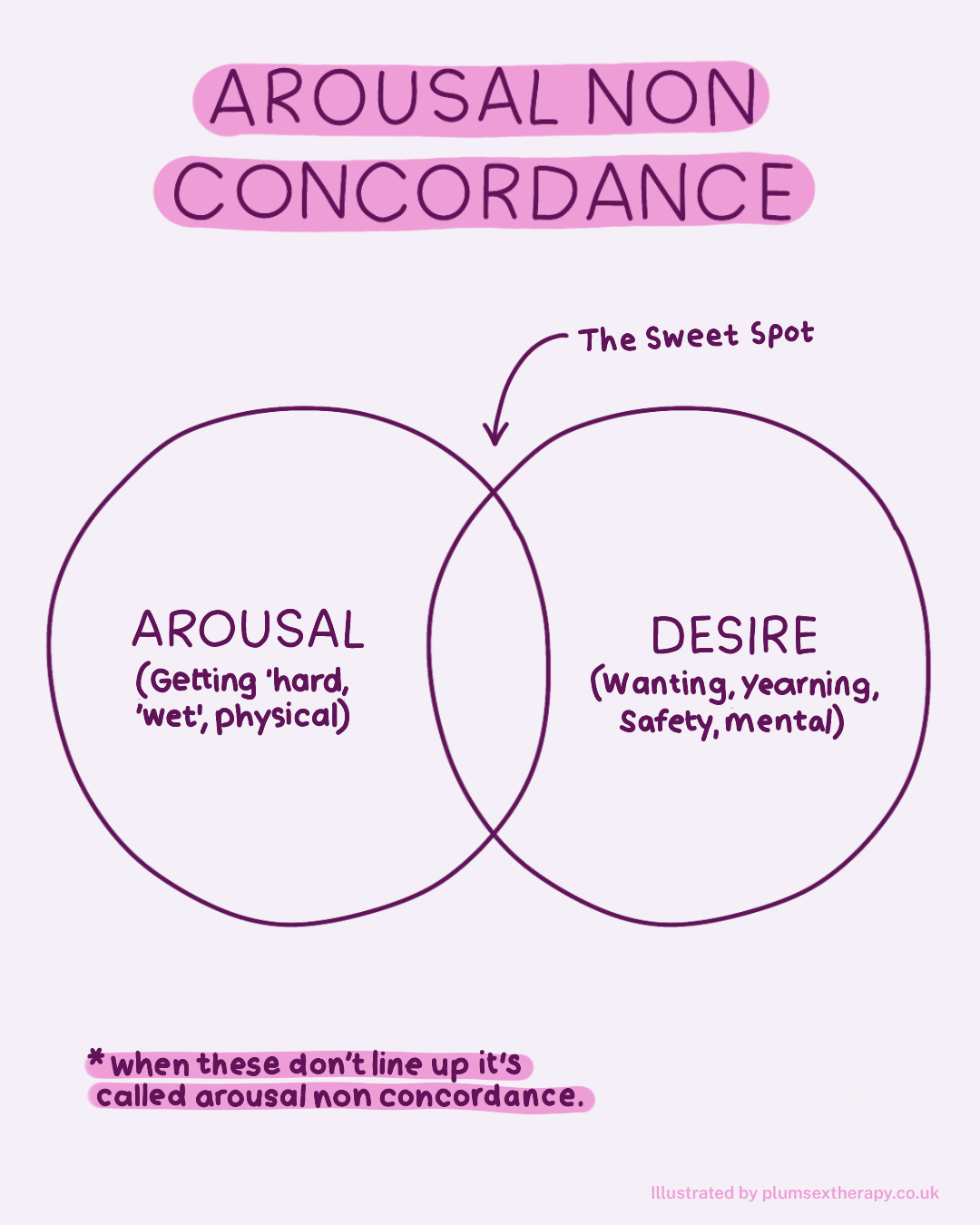
Image file name: arousal-non-concordance-diagram.svg Alt text: Arousal non-concordance diagram showing overlapping circles for desire and arousal Caption (goes under the image on the page): Desire and arousal overlap sometimes, not always. The sliver where they don’t is the whole point of this diagram. Image size: roughly 1200x960px Notes: keyword “arousal non-concordance” already sits in the title, H1, URL slug, the paragraph above the image, and the alt text. Carry it through to the image sitemap too if you’re using one.
When you’re into it, but your body isn’t playing along
This is the one most people quietly worry about: you want sex, you fancy your partner, you’re mentally all there, and your body is being stubborn. No lubrication, no erection, nothing that “matches” how turned on you feel.
It’s not a sign anything is wrong with you or your relationship. A few genuinely common reasons this happens:
Your brakes are on, even if you can’t feel them. Stress, tiredness, background anxiety, feeling watched or judged, even a slightly too-cold room can all quietly press the brakes without you consciously registering it. This is exactly the territory the dual control model maps out.
Your body might just need more direct input. Mental desire doesn’t automatically trigger physical arousal, especially for anyone whose arousal tends to be more responsive than spontaneous. Sometimes the body needs actual touch, more time, or more direct stimulation before it catches up with where your head already is. That’s not a flaw, it’s just how responsive desire works.
Medication and hormones can be involved. SSRIs, hormonal contraception, perimenopause and menopause can all reduce physical arousal responses like lubrication, even when desire itself is completely intact. If this is a persistent change rather than an occasional one, it’s worth a chat with your GP rather than assuming it’s you.
Neurodivergence can shape this too. Sensory sensitivity, interoception differences (how easily you notice and read signals from inside your own body) and a slower-to-settle nervous system can all widen the gap between what you want and what your body’s doing. None of that is a fault in how you’re wired, it just means the usual advice to “tune into your body” can be a lot less straightforward. If that sounds familiar, it’s worth a look at how I work with this in neurodivergent sex therapy and neurodivergent couples therapy.
None of this means you’re broken or that you don’t actually want what you think you want. Lube exists for exactly this reason, and it’s a completely normal, unremarkable part of a lot of people’s sex lives, not a last resort.
When it’s the other way round: your body responds, but you’re not into it
This direction gets talked about far less, but it matters just as much, and it can be genuinely confusing when it happens.
Genital arousal can be automatic. It’s largely run by the autonomic nervous system, the same system handling your heart rate and digestion without waiting for your permission, and it responds to a wide range of physical cues that have nothing to do with wanting sex. One theory, sometimes called the preparation hypothesis, suggests genital arousal in women may partly function to protect tissue from injury, increasing lubrication regardless of whether the person wants what’s happening (Suschinsky & Lalumière, 2011). If that holds up, it means the body can be quietly looking after itself even when your head wants no part of what’s going on.
This matters most seriously around consent. Genital arousal has sometimes been misread, in courtrooms, in relationships, in survivors’ own heads, as evidence that a person wanted sex or enjoyed it. It isn’t. A 2024 scoping review in Archives of Sexual Behavior found that physical arousal can and does occur in both male and female victims during sexual violence, alongside fear, dissociation and distress rather than instead of them (Miller et al., 2024). If this is something you’ve experienced, your body’s response was not an opinion, and it certainly wasn’t permission. This is often exactly the kind of thing that comes up in psychosexual therapy, and if cost is a barrier to getting support, my low cost and free support page has some places to start.
Away from anything that heavy, this direction shows up in gentler ways too. You can be wet or hard and simply not in the mood, mid-massage, first thing in the morning, watching something with an unexpectedly racy scene in it. That’s not your body contradicting you. It’s just doing its own thing, separately from what you actually want.
This isn’t the same for everyone
How wide this gap runs, and in which direction, varies a lot from person to person, and it isn’t fixed either. Stress levels, relationship dynamics, trauma history, hormones, neurodivergence and even how closely you’re paying attention in the moment can all shift it. Interestingly, that same 2010 meta-analysis found the gap between what people felt and what their bodies did narrowed when they rated arousal in real time rather than afterwards, so even the act of noticing and naming it can change things slightly.
This is also not a gendered rule that applies neatly to everyone. Non-concordance shows up across genders, orientations, relationship structures and neurotypes, and I see it just as often in the queer and LGBTQ+ couples and neurodivergent couples I work with as anyone else.
What actually helps
Whichever direction it runs in, the takeaway is the same: your body’s signals and your own wants are related but separate, and neither one overrules the other.
Checking in verbally beats checking the physical signs. If you’re with a partner, what they tell you is more reliable information than what you can see or feel happening physically. That’s true for every couple, but it matters even more where partners process and communicate differently, which is exactly what I cover in the double empathy problem, explained for neurodivergent couples.
If your body isn’t keeping up with your head, more warm up, more lube and less pressure usually help far more than waiting for spontaneous arousal to show up on cue.
And if your body’s ahead of your head, that’s just as normal. It doesn’t need fixing, and it definitely doesn’t need explaining to anyone.
If you recognise yourself in this
I’m a psychosexual and relationship therapist based in Brighton and Hove, and I work with individuals and couples who are trying to make sense of exactly this: a body that doesn’t seem to match what they want, or a head that hasn’t caught up with what their body’s doing. Neither one is something to fix in isolation, and neither one is a verdict on your desire, your relationship, or, if this has come from something non-consensual, on what happened to you.
If you’d like to talk it through, you can find out more about how I work, see pricing, or book a free 15 minute chat to see if it’s a good fit.
FAQs
Does arousal non-concordance mean I can’t trust my own body?
No. It means your body’s arousal and your head’s desire are two different systems that don’t always agree, not that either one is wrong. You can learn to notice both without treating physical arousal as the final word on what you want.
Is it normal to want sex but not get wet or hard?
Very. Desire doesn’t automatically switch physical arousal on, especially if you tend towards responsive rather than spontaneous desire. More direct stimulation, more time, and lube usually close the gap.
Is arousal non-concordance the same for everyone, regardless of gender?
Most research so far shows a wider average gap between desire and arousal for people with vulvas, but non-concordance happens for people of all genders and anatomies. It’s a spectrum rather than a strict divide, and research on trans, nonbinary and intersex experiences of it is still catching up.
If I got wet or hard during something I didn’t want, does that mean I consented?
No. Arousal is a physical response, often automatic, and it isn’t the same thing as desire, agreement, or enjoyment. Consent is about what you said and did, not what your body did on its own.
Does being neurodivergent make arousal non-concordance more likely?
It can widen the gap for some people. Sensory processing differences and interoception (how clearly you notice signals from inside your body) can make it harder to read your own arousal or desire accurately in the moment, in either direction. It’s a difference in how information reaches you, not a sign anything’s wrong with your body or your sexuality.
References
- Chivers, M. L., Seto, M. C., Lalumière, M. L., Laan, E., & Grimbos, T. (2010). Agreement of self-reported and genital measures of sexual arousal in men and women: a meta-analysis. Archives of Sexual Behavior. https://pubmed.ncbi.nlm.nih.gov/20049519/
- Suschinsky, K. D., & Lalumière, M. L. (2011). Prepared for anything? An investigation of female genital arousal in response to rape cues. Psychological Science. https://journals.sagepub.com/doi/10.1177/0956797610394660
- Miller et al. (2024). Victim sexual arousal during nonconsensual sex: A scoping review. Archives of Sexual Behavior. https://link.springer.com/article/10.1007/s10508-024-02852-2
- Moyle, K. (2023). The Science of Sex: Every Question About Your Sex Life Answered. DK/Penguin Random House.
- Nagoski, E. (2015). Come As You Are: The Surprising New Science That Will Transform Your Sex Life. Scribe.