

Couples turn up in my room fairly often with one version of the same worry: “he just doesn’t get me,” or “she takes everything so literally,” or “I explain it so clearly and it still doesn’t land.” Usually one partner is autistic, or ADHD, or otherwise neurodivergent, and the other isn’t, and both of them …


Couples turn up in my room fairly often with one version of the same worry: “they just doesn’t get me,” or “they takes everything so literally,” or “I explain it so clearly and it still doesn’t land.” Usually one partner is autistic, or ADHD, or otherwise neurodivergent, and the other isn’t, and both of them have quietly decided the mismatch is a fault. Usually it’s assumed to be the neurodivergent partner’s fault, because that’s the one whose communication style gets called “the problem” by default.
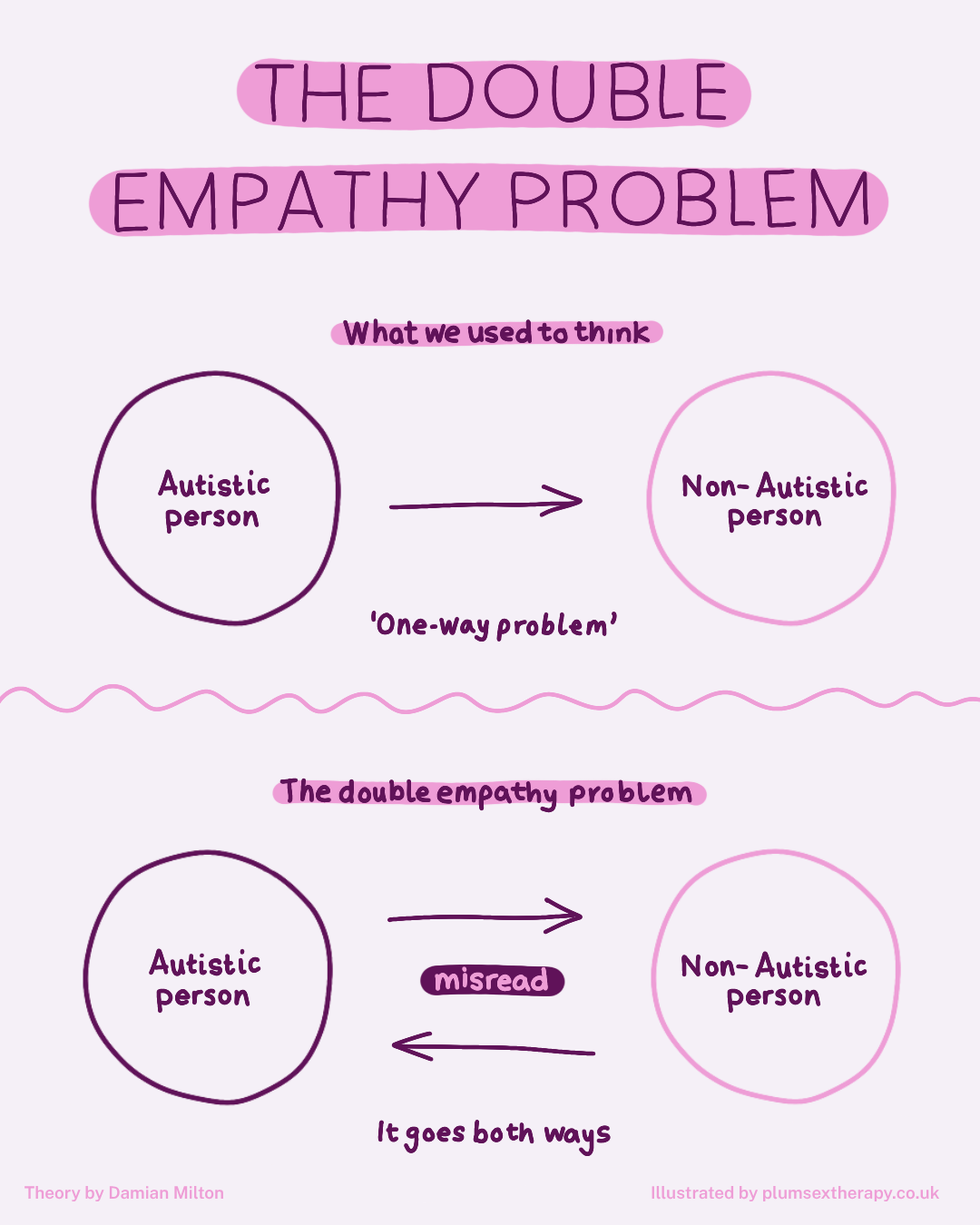
There’s a theory that says that’s the wrong way round, or at least an incomplete one. It’s called the double empathy problem, and it changes the whole conversation.
What the double empathy problem actually says
The theory comes from autistic researcher Damian Milton, who published it in 2012. The old assumption in autism research was that autistic people lack empathy or “theory of mind,” meaning they struggle to understand what other people are thinking and feeling.
Milton’s argument: that’s not what’s happening. Autistic and non-autistic people experience the world and express emotion differently from each other. That produces mutual misunderstanding, not a one-way deficit.
Both sides find each other hard to read. The autistic partner isn’t uniquely bad at empathy. Neither is the non-autistic one. They’re just running different systems for reading tone, intention, and emotional signals, and each system reads the other one as slightly foreign.
The “double” is the point. It’s not one person’s problem to fix.
The research backs this up
A 2020 study by Catherine Crompton and colleagues tested this directly. They had groups pass a story along a chain of people, like an updated game of telephone: autistic-only chains, non-autistic-only chains, and mixed chains with both.
Autistic-to-autistic chains passed the story along just as accurately as non-autistic-to-non-autistic chains did. No difference. Autistic people were not worse at communicating, full stop.
It was only the mixed chains where accuracy dropped sharply, and where people rated the interaction as less rapport-building, less easy, less enjoyable. The breakdown wasn’t about autism. It was about the mismatch between neurotypes.
What this means for a mixed-neurotype relationship
If one of you is neurodivergent and the other isn’t, you’re not dealing with one partner who communicates well and one who doesn’t. You’re both translating a foreign language in real time, and you’ve probably never been told that’s what’s happening.
A few places this shows up:
Directness gets misread both ways. A blunt, literal statement from a neurodivergent partner can land as cold, even when it’s meant as clear and honest. A softened, indirect statement from a non-neurodivergent partner can be genuinely unreadable to a partner who needed the actual words.
Silence means different things. For one of you, going quiet after a hard conversation might mean processing. For the other, it might read as punishment or withdrawal. Both readings make sense from inside each person’s own operating system.
Body language isn’t a shared alphabet. Eye contact, tone of voice, facial expression: none of it means the same thing to both of you by default, however much either partner assumes it should.
Processing speed isn’t the same as caring less. Needing time before responding, or needing an answer immediately, are both just how a nervous system works. Neither is a verdict on the relationship.
Why “just communicate better” misses the point
This is the advice most couples have already tried, and it usually quietly lands on one partner: normally whoever’s communication style is treated as the unusual one. Milton’s whole point is that this is backwards. Non-autistic communication only looks like the “normal” one because more people do it that way, not because it’s inherently clearer or more correct.
Real progress isn’t one partner learning to perform the other’s style better. It’s both partners learning that they’re translating, and sharing the work of building a version of communication that actually works between the two of you specifically.
What actually helps
Name the mismatch, not the person. “We’re reading this differently” lands very differently from “you’re bad at this” or “I’m bad at this,” and it’s usually more accurate too.
Build your own shared glossary. Agree, outside of an argument, what specific words and signals actually mean for each of you. What does “I’m fine” mean when you say it. What does a long pause mean when your partner does it.
Ask instead of assuming. Neither of you can reliably read the other’s internal state from tone or expression alone, so checking in directly tends to work better than guessing and then reacting to the guess.
Let processing speeds differ without a verdict attached. A partner who needs to think before responding isn’t creating distance. A partner who needs an answer sooner isn’t being impatient. Both are just describing what they need.
Share the translation work. This is the one that actually changes things long term: the effort of understanding each other stops being one partner’s job and becomes something you’re both doing.
It isn’t only autism
The original research is about autistic and non-autistic communication specifically, but the same shape shows up with ADHD, AuDHD, and other kinds of neurodivergence in a relationship: different pacing, different attention patterns, different ways of expressing care, all of it read through a partner’s own operating system rather than the one it was actually sent in.
None of that means anything is wrong with either of you. It means you’ve been given two different manuals and never told you were reading from different ones.
If you recognise yourselves in this
If this sounds like your relationship, that’s common, and it’s exactly the kind of thing neurodivergent couples therapy is built for.
I’m a psychosexual and relationship therapist based in Brighton and Hove, and I work with neurodivergent and mixed-neurotype couples on exactly this: building a shared way of communicating that doesn’t ask either of you to stop being who you are. Neither of you is doing this wrong. You’re just working from different manuals, and nobody handed either of you a translation guide.
References
- Milton, D. E. M. (2012). On the ontological status of autism: The ‘double empathy problem’. Disability & Society, 27(6), 883–887. https://doi.org/10.1080/09687599.2012.710008
- Crompton, C. J., Ropar, D., Evans-Williams, C. V. M., Flynn, E. G., & Fletcher-Watson, S. (2020). Autistic peer-to-peer information transfer is highly effective. Autism, 24(7), 1704–1712. https://doi.org/10.1177/1362361320919286