


Most people who come to psychosexual therapy about a behaviour they can’t seem to stop have already tried the obvious thing. They’ve promised themselves they’d stop. Usually at about 1am, usually with total conviction. And then by Thursday they’re back where they started, holding one more piece of evidence that something is wrong with them.


Most people who come to psychosexual therapy about a behaviour they can’t seem to stop have already tried the obvious thing. They’ve promised themselves they’d stop. Usually at about 1am, usually with total conviction. And then by Thursday they’re back where they started, holding one more piece of evidence that something is wrong with them.
That broken promise isn’t a character flaw or a willpower problem. It’s a step in a loop. And once you can see the whole loop, you can start interrupting it somewhere other than the place that never works.
What the shame cycle actually looks like
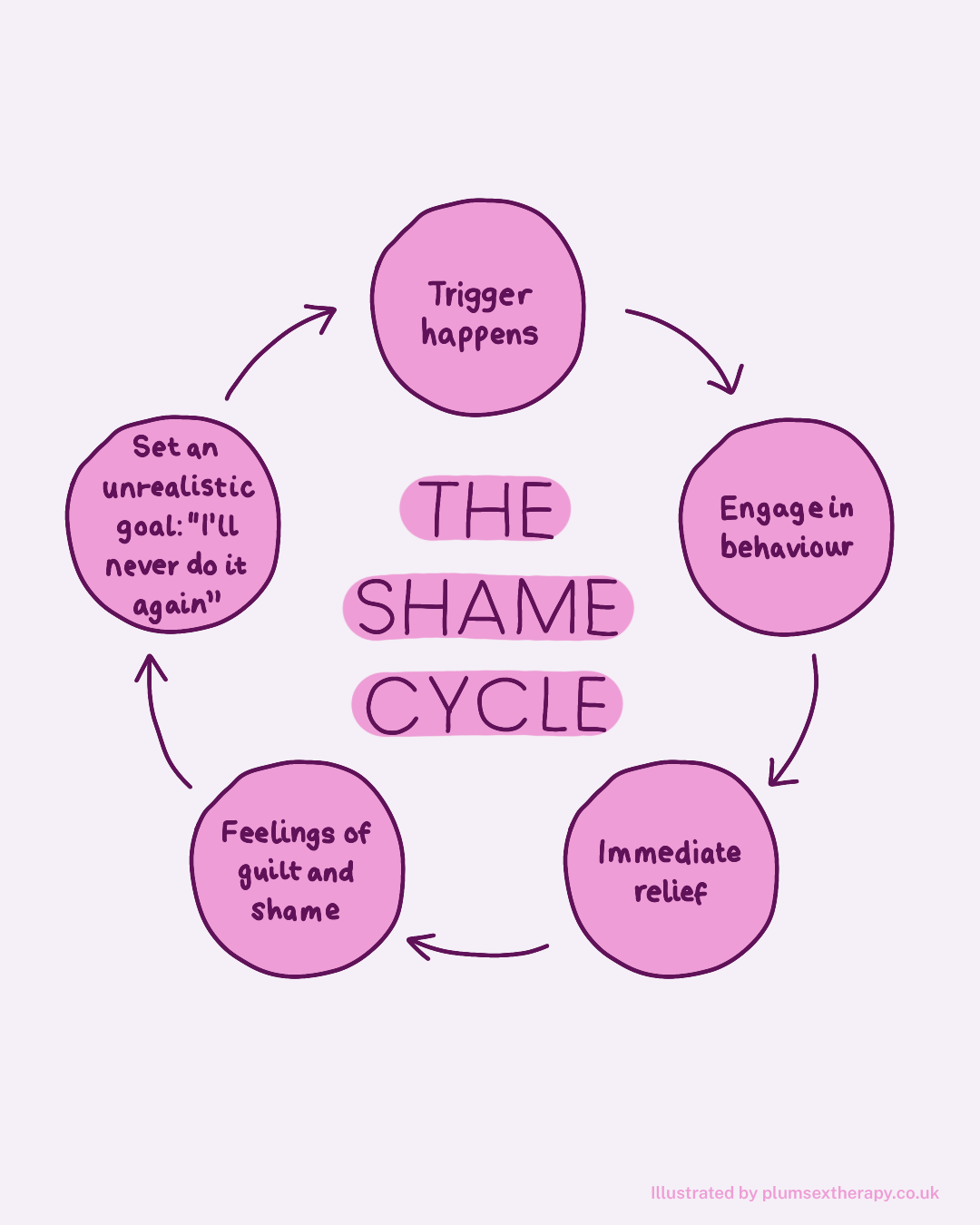
Five steps, and each one hands over neatly to the next.
1. A trigger happens. Often nothing to do with sex at all: stress, boredom, loneliness, an argument, being overtired, a feeling you don’t have words for yet. Sometimes it’s just an empty evening and a phone within reach. The trigger isn’t the problem, it’s the doorway.
2. You engage in the behaviour. For some people that’s porn, for others it’s hooking up, sexting, spending, drinking, scrolling. Your version is your version.
3. Immediate relief. This is the step people skip past when they tell me the story, and it’s the most important one on the diagram. The behaviour works. Not for long, but it works, which is precisely why it’s still in your life. It settles the nervous system, changes the channel, buys you twenty minutes off from whatever you were feeling. If it did nothing for you at all, you’d have stopped years ago without needing to try.
4. Feelings of guilt and shame. The relief drains away and something heavier fills the gap. Not “I did a thing I’d rather not have done,” but “I’m the kind of person who does this.” Guilt is about behaviour. Shame is about self. Shame is the one that does the damage.
5. An unrealistic goal: “I’ll never do it again.” Apps deleted, accounts blocked, promise made. It feels like taking control back. It feels like the responsible thing to do. But it sets the bar somewhere no human being can stand, because “never again” turns the very first slip into total failure. And total failure is a feeling, a big one, which makes it a trigger. Back to step one, and the loop is a little tighter than it was last time round.
That’s the bit worth sitting with. The shame isn’t the brake on this cycle. It’s the fuel.
Why this shows up so often with porn and compulsive sexual behaviour
Any behaviour can run this loop: eating, drinking, spending, gambling, doomscrolling. But sex is where it tends to run hardest, because sex is the area most of us were already carrying shame about long before anything got difficult. Step four never has to start from scratch.
COSRT-accredited psychotherapist Silva Neves, who wrote one of the main clinical texts on compulsive sexual behaviour, makes the case for moving away from the language of “sex addiction” towards evidence-based, sex-positive treatment. Not because behaviour can’t genuinely get out of hand, it can, and it can cost people relationships, sleep and jobs, but because a framework built on the idea that you’re broken tends to feed the exact shame that keeps the cycle turning.
The amount also matters far less than people expect. Research by psychologist Joshua Grubbs on what’s called moral incongruence found that distress, and the sense of being addicted, track much more closely with how much someone disapproves of their own use than with how much they actually use. Two people can do the same thing on the same evening. One goes to sleep. The other starts round four of the cycle. What differs is the story it sets off, and that story almost always arrived long before, from family, faith, culture, sex education, or whatever you absorbed about what your desire says about you.
Which also means “too much” isn’t a number anyone can hand you. The useful questions are whether it’s costing you things you actually care about, and whether you still feel like you have a choice in it.
Where the shame part comes from
Worth saying plainly: the shame in step four is rarely manufactured by the behaviour itself. It turns up already made, and it usually starts years earlier and somewhere else entirely. That’s a whole post of its own, and I’ve written it here: where sexual shame actually starts.
Breaking the cycle
Five steps means five places to intervene, and step two, the behaviour itself, is the hardest of them. So we usually start elsewhere.
Get curious about step three. Psychosexual therapist and researcher Lisa Etherson‘s Shame Containment Theory is useful here: her work is aimed at helping someone “understand what sexual behaviours are being used to help you manage unwanted emotions,” which reframes the behaviour as a strategy rather than a defect. So: what was the relief actually doing? Numbing something? Soothing something? Keeping you company? Once you know what job the behaviour is doing, you can start finding other ways to get that job done.
Swap step five for something a human could actually manage. Relapse-prevention research describes what happens when a strict rule gets broken: the slip itself becomes proof of failure, and the proof triggers a far bigger episode than the slip ever would have been. “Never again” more or less guarantees it. “Not tonight,” “not alone in the house,” “not on my phone in bed,” and “if it happens I’ll look at what was going on rather than what’s wrong with me” is much less satisfying to promise and considerably more effective.
Interrupt at step one. Most people’s triggers turn out to be fairly predictable once they’ve been written down for a fortnight. Predictable is workable.
Say it out loud to one person. Shame is remarkably bad at surviving contact with someone who doesn’t flinch. That can be a partner, a friend, or a therapist, but it does need to be someone.
It’s also worth naming that this loop isn’t identical for everyone. If you’re neurodivergent, impulsivity, dopamine-seeking and rejection sensitivity can make the cycle faster and steeper, and “why can’t I just stop” lands considerably harder. If you’re LGBTQ+, you may have spent years being told your desire was itself the problem, so step four had a very long head start. And in plenty of families and cultures, the messaging wasn’t disapproval so much as complete silence, which leaves you to fill in the blanks yourself, usually unkindly.
If you recognise yourself in this
If reading that felt uncomfortably familiar, that’s common, and it’s exactly the sort of thing psychosexual therapy is for. Nothing about this cycle means you’re broken, and nothing about it means your sexuality is the enemy.
I’m a psychosexual and relationship therapist based in Brighton and Hove (working online across the UK), and I work with individuals and couples untangling exactly this: shame, secrecy, behaviour that’s stopped feeling like a choice, and the belief that wanting what you want makes you a bad person. It doesn’t. You just weren’t taught how any of this works, so how would you know.
References
- Neves, S. (2021). Compulsive Sexual Behaviours: A Psycho-Sexual Treatment Guide for Clinicians. Routledge.
- Grubbs, J. B., Exline, J. J., Pargament, K. I., Hook, J. N., & Carlisle, R. D. (2015). Transgression as addiction: Religiosity and moral disapproval as predictors of perceived addiction to pornography. Archives of Sexual Behavior, 44(1), 125–136. https://doi.org/10.1007/s10508-013-0257-z
- Etherson, L. (2023). Shame containment theory – a new approach to shame. Attachment: New Directions in Psychotherapy and Relational Psychoanalysis, 17(2), 141–154. https://doi.org/10.33212/att.v17n2.2023.141